Art studios and schools that buy air dry clay in bulk often discover that their second or third batch feels different from the first—harder to shape, crumbly, or covered in mold. The problem is almost never the manufacturer. It is storage.
Unlike kiln-fired clay, air dry clay remains reactive to air and moisture even in its sealed packaging. Understanding how to store it correctly directly affects whether a five-kilogram bulk pack lasts one semester or the entire academic year.
How long does unopened air dry clay last?
Unopened air dry clay stored at room temperature—between eighteen and twenty-four degrees Celsius, away from direct sunlight—typically remains usable for twelve to twenty-four months from the production date. The key variable is the integrity of the original packaging. Even a pin-sized puncture in the plastic wrap allows moisture to escape, beginning the drying process from the outside in.
Schools buying for an entire academic year should request production-date labeling on bulk orders and use the oldest stock first. A simple “first in, first out” rotation system prevents unused clay from silently aging in the back of the supply closet.
What happens when air dry clay goes bad?
Degraded air dry clay shows three distinct symptoms. First, the texture becomes crumbly and resists smoothing—you will feel small hard lumps when kneading. Second, mold spots appear, typically white, gray, or green, especially in humid climates. Mold grows because the organic binders in the clay provide nutrients when trapped moisture cannot escape. Third, the clay develops a hardened outer shell while the interior remains soft. This “case hardening” means the packaging failed at some point.
Clay showing mold should not be used with children, even if scraped off. The spores have penetrated deeper than the visible surface. Hardened or crumbly clay can sometimes be revived by kneading in small amounts of water—a few drops at a time—but the revived clay will never match the workability of fresh product and should be used for practice rather than finished pieces.
How should schools store bulk clay between classes?
Art teachers running multiple classes per day face a different problem than warehouse storage. Clay opened at nine in the morning and left uncovered until four in the afternoon will already begin to dry at the edges. The solution is a three-container system.
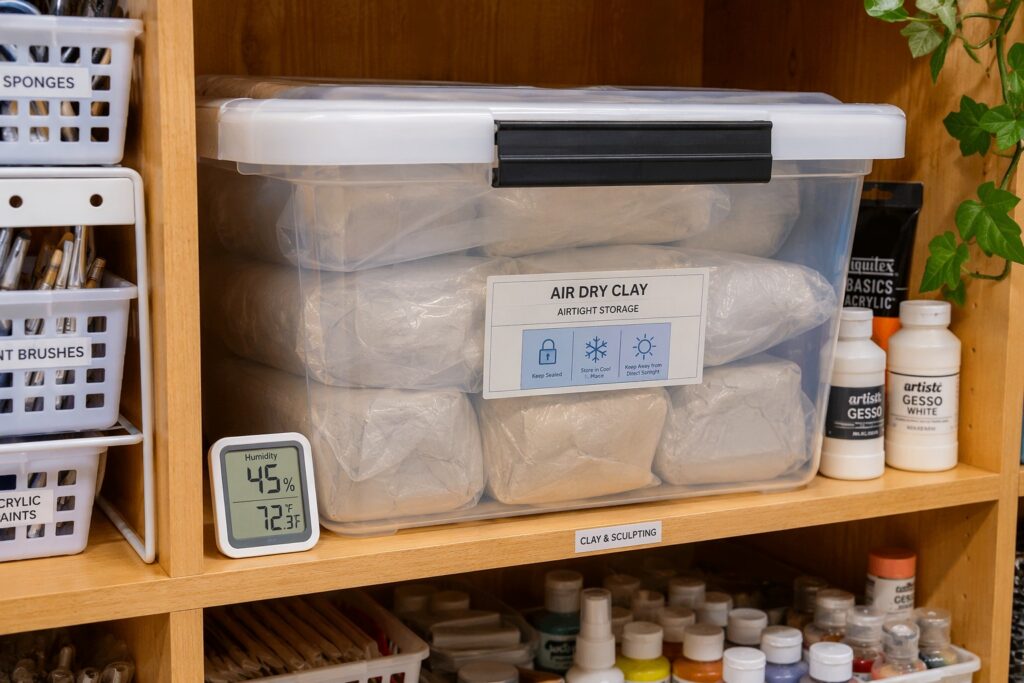
Container one holds unopened bulk packs in the original packaging, stored in a cool, dark cabinet. Container two is a large airtight plastic bin that holds the clay currently in rotation—the five to eight kilograms that will be used this week. This bin should be opened only to remove clay, then immediately sealed. Container three is a small airtight box for each student group’s work-in-progress. Individual resealable bags inside the group box prevent cross-contamination of colors and keep each student’s clay identifiable.
Adding a damp sponge or a small cup of water next to the clay inside the sealed container—not touching the clay itself—creates a humidity-rich environment that slows drying significantly. Replace the sponge weekly to prevent mold growth from the sponge itself.
What storage conditions ruin air dry clay the fastest?
Three environmental factors destroy bulk clay quickly. Direct sunlight heats the packaging unevenly, creating condensation inside the plastic wrap that triggers localized mold growth within days. Temperatures above thirty degrees Celsius accelerate the chemical curing process even in sealed packaging, effectively halving the shelf life. Freezing temperatures cause the water content to crystallize, permanently ruining the clay’s plasticity—frozen and thawed clay will never regain its original workability.
Storage closets with water pipes running through them are a common hidden problem in school buildings. The pipes raise ambient temperature and humidity even when the closet itself feels cool. The ideal storage location is a dry, interior closet on a ground floor, away from exterior walls that transfer outdoor heat.
How can studios maximize shelf life when buying in bulk?
Studios that buy one hundred to two hundred kilograms of clay at a time for workshops should invest in the original packaging, not repackage. Factory-sealed packs have been produced in a controlled environment with minimal trapped air. Repackaging at the studio introduces ambient humidity and bacteria, shortening shelf life by months.
If a studio must split bulk clay into smaller portions for distribution to instructors, vacuum-sealing is the best method. A standard food vacuum sealer works well with one to two kilogram portions. If vacuum sealing is not available, double-bagging with heavy-duty zip bags and squeezing out as much air as possible is an acceptable alternative. Wrapping clay tightly in plastic film, then placing the wrapped block inside a sealed bag, provides a third layer of protection.
How to verify clay freshness when receiving a bulk order
Upon receiving a bulk shipment, open one pack from a random box and check three things. The clay should feel uniformly soft and pliable with no hard lumps. The color should match the reference sample across the entire surface of the block. The packaging should be intact with no punctures, and the clay should not feel cool or damp to the touch—signs of internal condensation.
If any pack fails this check, photograph it, photograph the batch number on the box, and contact the supplier immediately. A reputable manufacturer will replace the affected shipment or issue a credit. Siglo Toy includes batch numbers on all bulk packaging and provides reference color samples with every wholesale order for this exact purpose. Free samples with full documentation are available for qualified buyers to test before committing to a full order.
